For more than 20 years, before becoming investors, we built software companies and implemented technology inside real businesses. We learned that innovation may arrive overnight; adoption does not. Enterprises need time to change workflows, budgets, incentives and behaviour before new technology produces measurable value.
Loading...
AI is now moving from fascination to implementation. The noise, FOMO and premature winner-picking will continue. But the more important phase is only beginning: turning abundant intelligence into productivity, revenue and operating leverage.
Capital is concentrating around the infrastructure that creates intelligence. We believe many of the defining enterprise companies of the next decade will be built one layer above it—inside the workflows where models acquire context, perform dependable work and produce outcomes customers will pay for.
Pic. Brooklyn Bridge, looking toward Lower Manhattan through the morning fog. We will be back in New York in the second half of September.
1) The power law is moving through the industry
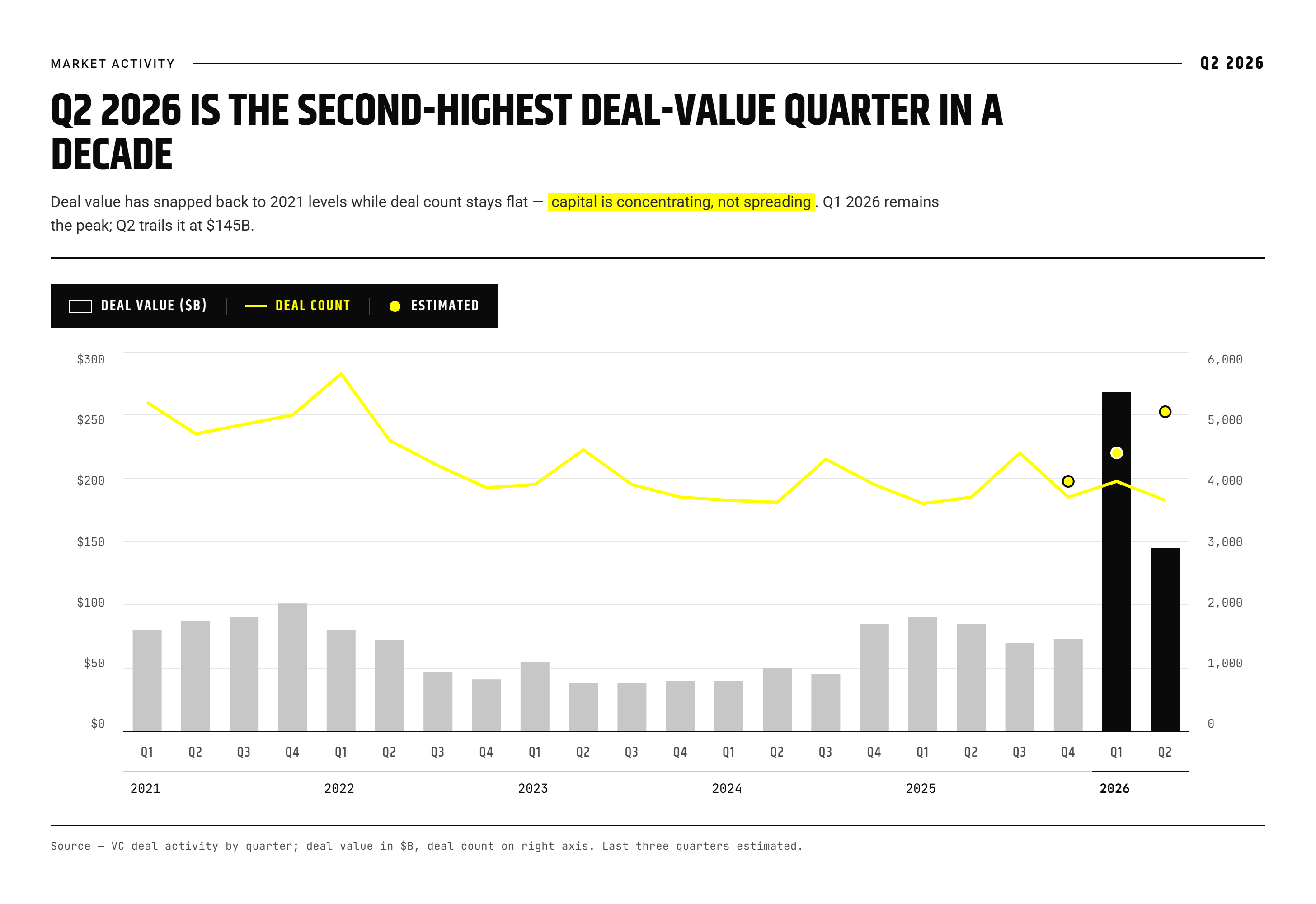
According to the PitchBook–NVCA Q2 2026 Venture Monitor, US venture investment reached $412.7 billion in the first half of 2026—already more than the total invested during all of 2025.1 Globally, CB Insights recorded the second-highest quarterly funding total in history.2
But this is not a broad boom. Global deal count declined by 11% in the second quarter and reached its lowest level in approximately a decade. In the US, rounds of $100 million or more accounted for 87.5% of all capital invested during the first half. AI companies captured 86% of US venture dollars.
A very small number of companies—most notably OpenAI, Anthropic and xAI—have become large enough to make an uneven market look extraordinarily healthy.
That is the first contradiction of today’s venture market: record amounts of capital are being deployed, while the market beneath those totals continues to narrow.
Venture capital has always been governed by the power law: a small number of investments generate most of a fund’s returns. What is becoming clearer is that the same law applies to venture investors themselves.
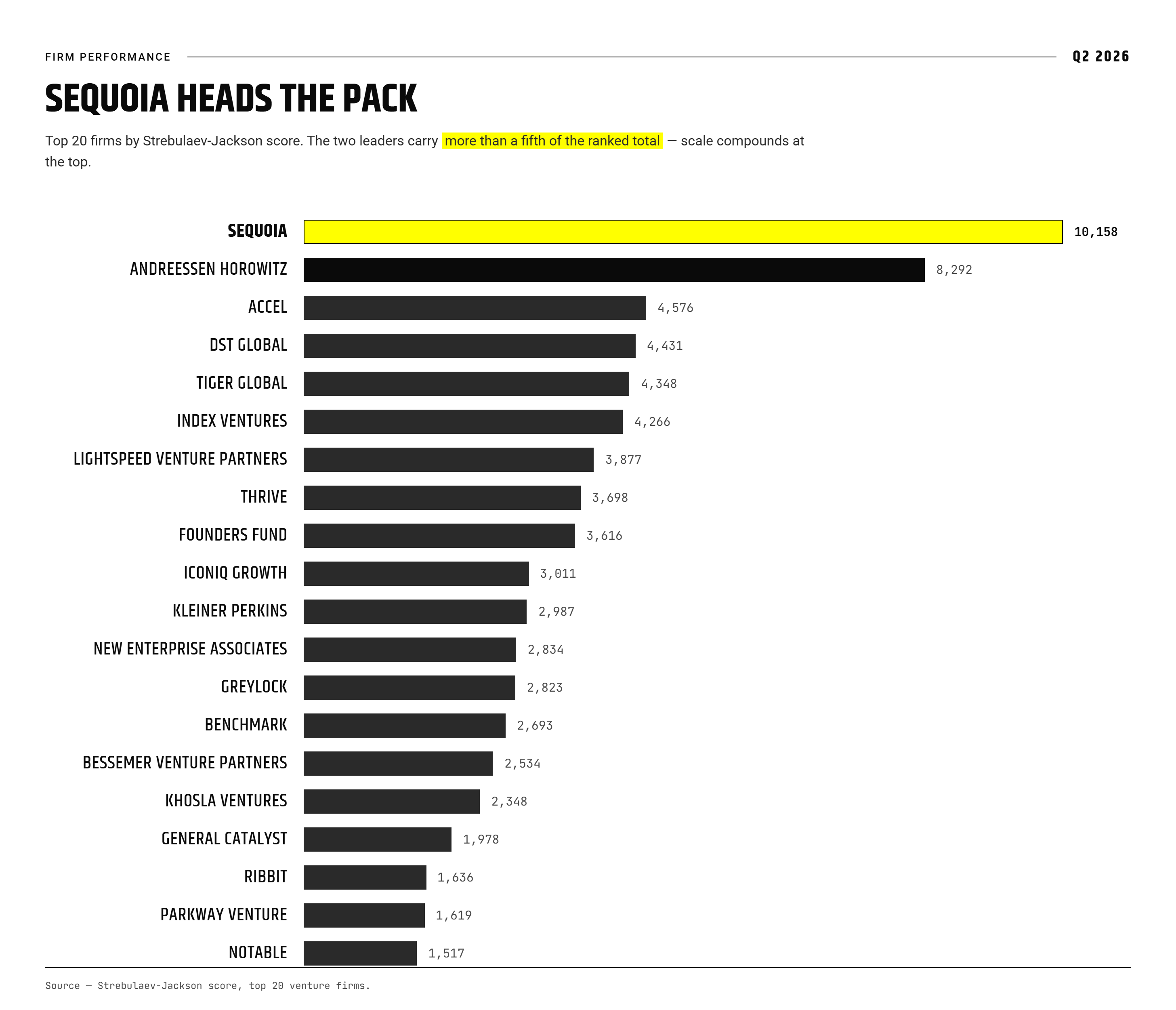
Research by Ilya Strebulaev and Blake Jackson from 26 Jun 2026, based on more than 100,000 venture professionals, estimates that 5% of venture investors have generated approximately 90% of the industry’s profits.3
The same power law now appears at five levels:
A few companies attract most of the capital.
A few exits create most of the liquidity.
A few investments generate most of the returns.
A few venture firms capture most of the profits.
A few large managers attract most new LP commitments.
PitchBook reports that 73.1% of US venture commitments closed during the first quarter went to five firms. As fund sizes grow, many leading venture platforms are moving into increasingly large, later-stage transactions.
This is not inherently a problem. Capital-intensive model laboratories and mature private companies require investors capable of deploying billions. But it is a different activity from discovering and building companies at formation.
As John Thornhill observed in the Financial Times, the boundaries between venture capital, growth equity, private equity and traditional asset management are blurring.4
That creates an opening at the other end of the market: small, specialized and operator-led investment before companies become obvious.
In a power-law industry, being smaller is not itself an advantage.
Being more specific can be.
2) More intelligence is not the same as more productivity
The concentration described above is most visible in artificial intelligence. Investors appear to be equating larger models with larger economic outcomes, directing unprecedented amounts of capital toward compute, data centres and foundation-model development.
Ghodsi, co-founder and CEO of Databricks, offers a provocative counterpoint.
Speaking at Stanford’s 2026 course on the economics of the AI supercycle, Ghodsi argued that the industry should “chill out.”5 The race toward vaguely defined superintelligence, he suggested, is creating anxiety, tunnel vision and poorly considered investment decisions.
His more important observation is operational rather than philosophical: models are already extraordinarily intelligent, yet most enterprises have experienced relatively little transformation.
Companies are experimenting with copilots, proofs of concept and isolated productivity tools. But most large organizations are not populated by autonomous agents reliably performing work alongside humans. Their underlying processes remain largely unchanged.
The question is therefore not only how intelligent models will become.
It is why intelligence that is already available has produced so little observable organizational change.
Ghodsi’s answer is simple: context.
3) Every company has a John or Jane
What does “context” mean inside a company? It often looks like a person colleagues describe in similar terms:
“Ask John.”
“Jane knows how that really works.”
That person may have spent 10, 20 or 30 years inside the company. They know where the authoritative information lives, which written processes are outdated, which exceptions are legitimate and who must be consulted before a decision can be implemented.
They understand not only the official workflow, but the organization’s accumulated institutional memory.
Models generally do not possess that knowledge.
They may be capable of solving complex mathematical problems, generating software or interpreting a contract. But without organizational context, they do not know why a particular customer received an exception three years ago, which internal policy supersedes another, or why a seemingly logical action would create a compliance problem.
The result resembles a brilliant new employee who has received no onboarding, has access to the wrong systems and does not know which rules can never be broken.
Training an even larger model does not automatically solve this problem. The enterprise must make that context accessible, structured, permissioned and usable.
In Ghodsi’s formulation, organizations have to transfer what resides in human heads into systems that machines can use. The challenge is to connect carbon with silicon.
That may prove to be one of the largest application opportunities of the AI era.
Our portfolio companies are building different versions of that bridge: LightFrame is encoding banking expertise and workflows into a next-generation core-banking and portfolio-management system; Cashflowy is turning financial data and bookkeeping expertise into automated accounting and real-time financial guidance for solopreneurs; and Virtual Scale is translating companies’ sales and service knowledge into AI agents that handle customer conversations across calls, WhatsApp and chat.
4) The model is becoming infrastructure
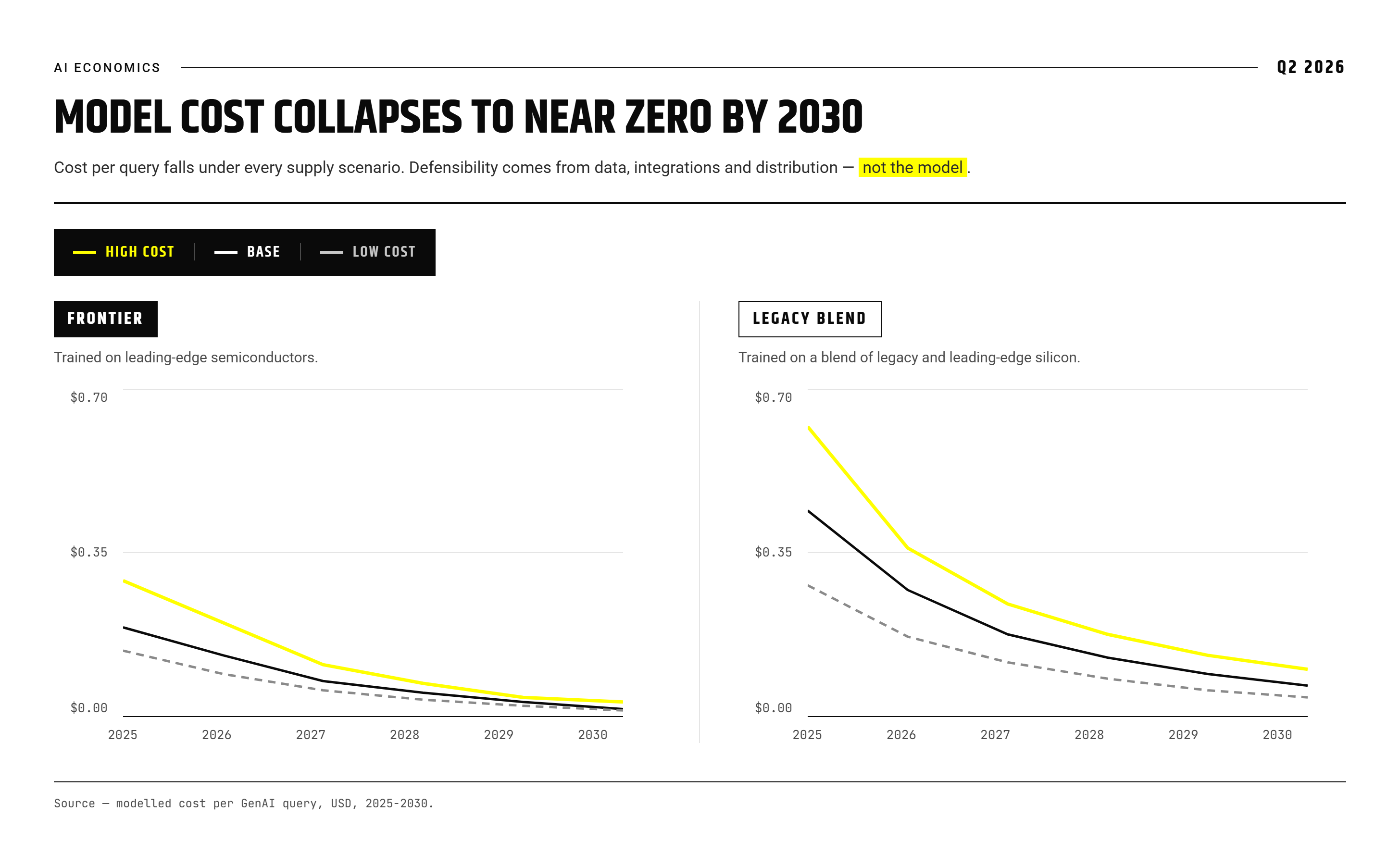
Foundation models will continue to improve. They will become faster, cheaper and more widely available. Open-source alternatives will place further pressure on pricing and differentiation.
Enterprises are also likely to remain model-agnostic. Different applications require different trade-offs across cost, speed, accuracy, data residency, compliance and availability. A company may use several proprietary and open models simultaneously and replace them as performance changes.
This means the model is increasingly a shared capability—not the complete product.
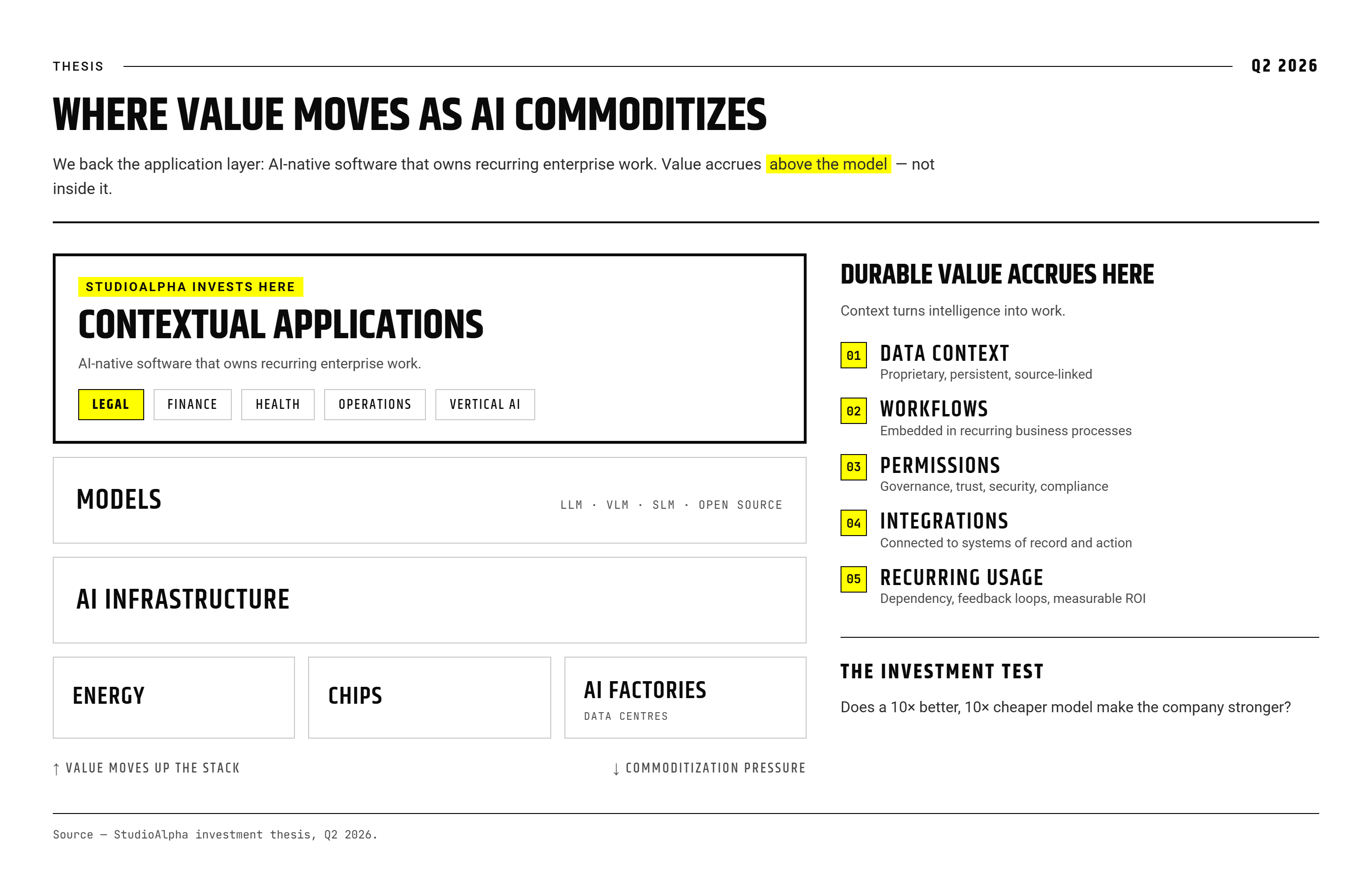
If access to intelligence becomes broadly available, durable application value must come from elsewhere:
Proprietary and continuously updated data
Deep understanding of a particular business process
Workflow design and orchestration
Permissions and governance
System integrations
Persistent memory
Security and regulatory compliance
Trust and auditability
Distribution and habitual usage
Superior user experience
These are the elements that allow general intelligence to perform specific, dependable work.
This leads to a useful investment test:
If the underlying model becomes ten times better and ten times cheaper, does the company become more valuable—or does its product disappear?
The strongest AI-native application companies should benefit from model improvement. Lower inference costs increase their margins or allow them to perform more work. Better reasoning expands what their products can handle. Model competition gives them more suppliers and reduces dependency.
At company level, this is the thesis: the company does not need to own the intelligence. It needs to own the workflow and context in which that intelligence becomes dependable.
5) Software is not dead
If artificial intelligence can produce code inexpensively, it is tempting to conclude that software is becoming worthless.
Ghodsi makes the opposite argument. OpenAI, Anthropic and Nvidia are themselves built through software and technical intellectual property. Software is clearly not disappearing.
What is disappearing is the scarcity of producing code.
That distinction is already visible in the data. A May 2026 NBER study of more than 100,000 software developers found that autonomous coding agents increased coding activity by 180%, but the gain fell to 30% when measured by actual software releases—and produced no increase in total application usage. AI can dramatically increase the amount of code written. Turning that code into software customers adopt and depend upon remains a different problem.6
AI reduces the cost of building a product. It may also reduce traditional switching costs. If users interact with an agent rather than navigating an application’s interface, familiarity with the old interface becomes less protective.
That creates a problem for software companies whose principal advantage is accumulated code, an aging user experience or customer inertia.
It does not eliminate other forms of defensibility.
A company can still possess economies of scale, proprietary data, trusted distribution, security certifications, a strong brand, regulatory approval or deep integration into a customer’s core operations. Incumbents that combine these advantages with rapid innovation may become stronger.
The companies most exposed are those that have spent a decade harvesting an installed base without materially improving the product.
AI does not kill software. It separates software that performs indispensable work from software that merely packages functionality.
The valuable company will not necessarily be the one with the most code. It will be the one customers depend on to perform consequential work.
6) The application opportunity
When asked how he would invest as a venture capitalist, Ghodsi described an early-stage, diversified seed strategy. He acknowledged that most investments would fail, while a small number could become the next generation’s defining companies.
He pointed to large, complex markets such as healthcare and education. These markets contain enormous pools of spending, but their workflows require far more than generic intelligence. Success depends on domain knowledge, trust, proprietary data and deep workflow expertise.
Ghodsi also argued that technological value repeatedly moves up the stack.
Value initially accumulated in computer hardware. As hardware commoditized, operating systems and software captured more of it. Virtualization, cloud computing and subsequent application layers repeated the pattern.
AI is unlikely to be different.
In Ghodsi’s Stanford discussion, this becomes the investment conclusion: as lower layers of the technology stack standardize, value migrates toward applications capable of combining that infrastructure with proprietary context, workflow expertise and customer trust. The economic pressure is already visible. Gartner forecasts that the cost of running a trillion-parameter model will decline by more than 90% between 2025 and 2030.7
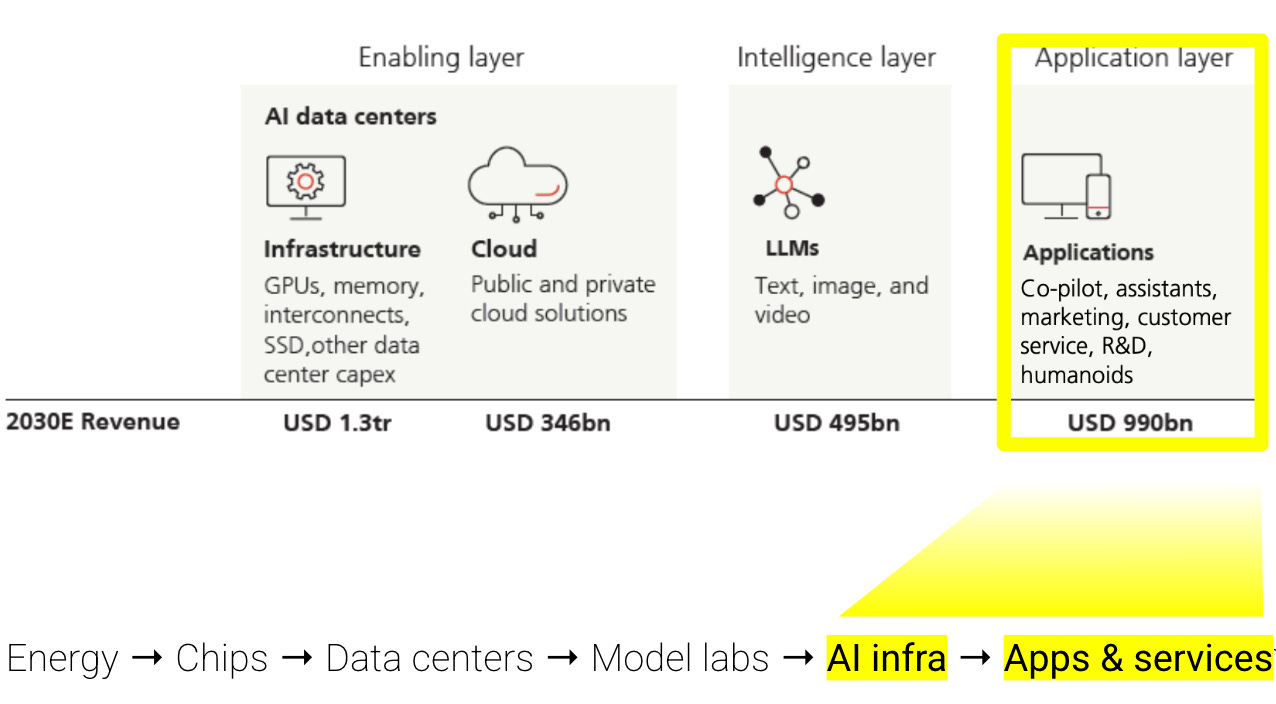
Today, a disproportionate share of AI economics sits in chips, compute and a few model providers. Over time, as each layer becomes more competitive, value should move toward the applications that solve complete customer problems.
This does not mean every AI application will be valuable. Many current products are thin wrappers around temporary model capabilities. Features that appear differentiated today may be included in the next foundation-model release.
The critical distinction is between applications that merely expose intelligence and applications that accumulate context.
B O X
MARKET VALIDATION: VALUE IS MOVING UP THE STACK
Ali Ghodsi, co-founder and CEO of Databricks, describes value moving toward the application layer as the underlying technology commoditizes.
UBS puts the magnitude of this opportunity at approximately USD 990bn in annual application-layer AI revenue by 2030. In January 2026, UBS went further, saying it expects the application layer to lead AI investment returns in 2026.
In our Q1 letter, we wrote that customers do not buy features. They buy outcomes.
That remains true.
A feature is capability. An output is produced work. An outcome is economic change.
What Q2 clarified is that reliable outcomes require context.
The gap between AI activity and business outcomes is measurable. BCG’s 2026 research found that many employees already save substantial time with AI, but organizations redesigning their workflows were 24 percentage points more likely to report measurable business improvement. The tool creates capacity. Workflow redesign determines whether that capacity becomes economic value.8
A model can generate a document, answer a question, summarize a file or automate a task. But the output only becomes valuable when it fits the customer’s workflow, respects the organization’s permissions and uses the right institutional knowledge.
A legal AI product is not interesting because it drafts a memo. It becomes interesting if a law firm can handle more matters with the same team, deliver faster turnaround and reduce errors without sacrificing trust.
A sales AI product is not interesting because it writes replies. It becomes interesting if it increases conversion, reduces support costs or shortens the sales cycle.
The strongest systems will also measure these outcomes continuously. They will not only do the work. They will show the customer what changed: hours saved, costs reduced, conversion improved, revenue added or risk lowered.
In other words, the software starts to prove its own value.
8) A concrete example: legal AI
Legal AI illustrates this transition.
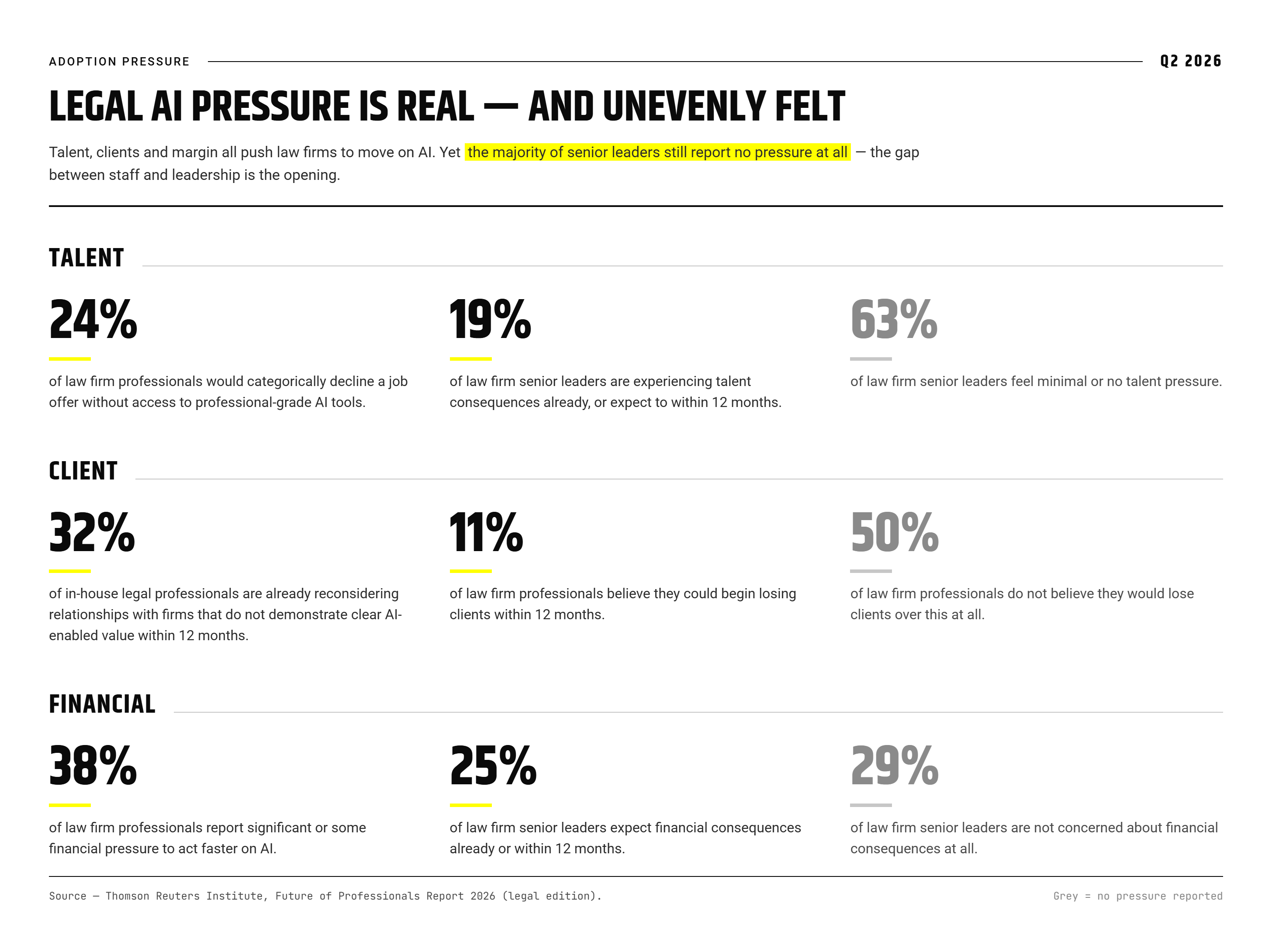
The professional standards are particularly demanding in legal work. Thomson Reuters’ 2026 legal-industry research argues that trustworthy legal AI must be grounded in authoritative sources, traceable reasoning and professional accountability. Those requirements make provenance and persistent matter knowledge part of the product—not optional features.9
First-generation products concentrated on drafting, research, summarization and document review. These capabilities remain useful, but foundation models increasingly provide them directly.
Complex legal matters present a different problem. They can involve thousands of documents, changing arguments, previous decisions, multiple participants and strict requirements around traceability.
A system that reconstructs this context every time it receives a question is expensive and unreliable. It may overlook a critical detail or generate an answer that cannot be connected to its source.
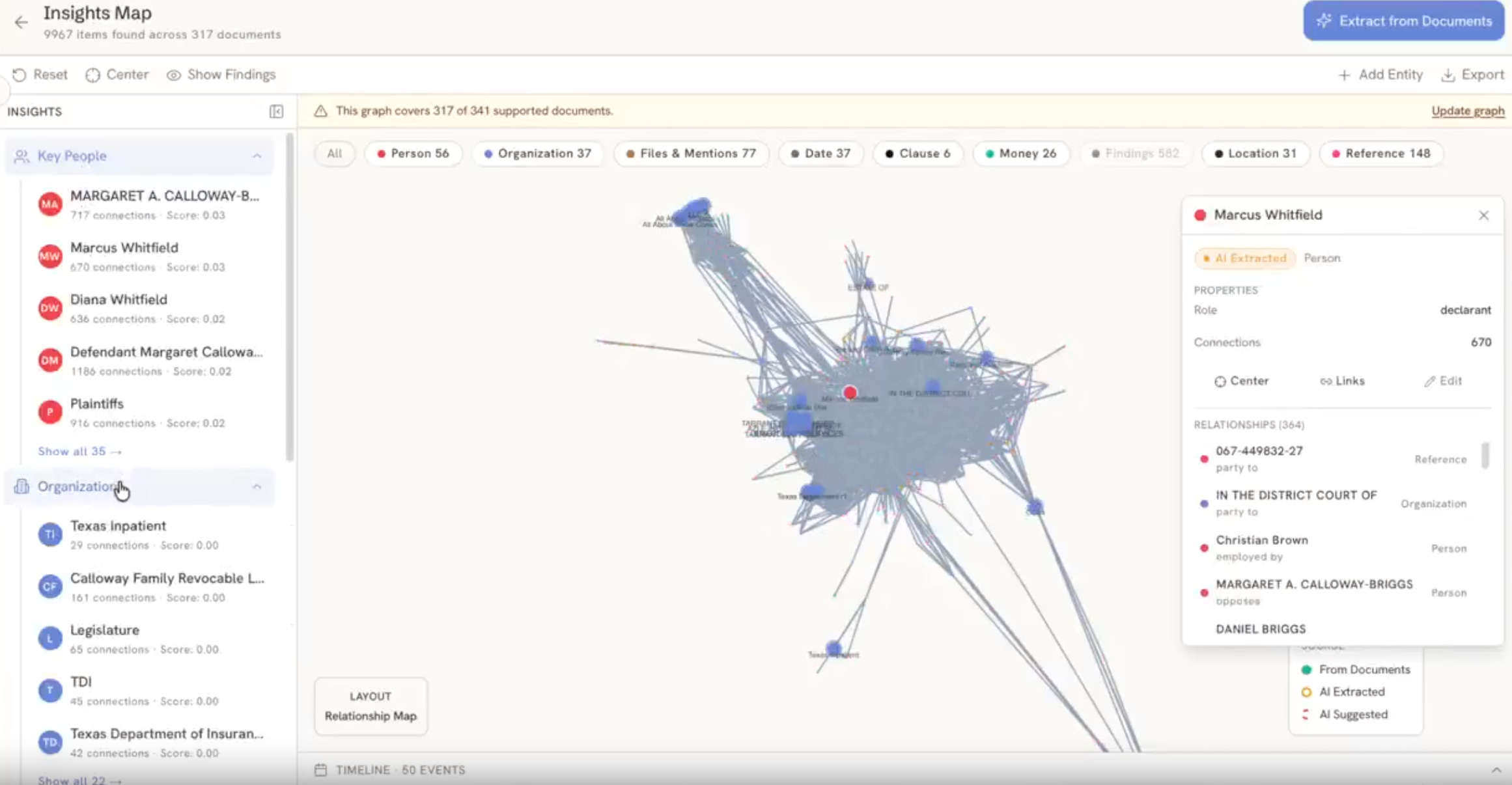
A persistent matter-intelligence layer is structurally different. It reads and organizes the matter, preserves source-linked knowledge and reuses that context across subsequent tasks.
Pic. Irys’ Insights Map, which visualiyes its matter/level knowledge graph. (source)
That is the thesis behind StudioAlpha portfolio company Irys, whose architecture gives drafting, research, document analysis and collaboration access to the same persistent matter context:
The winner will not own the best model. It will be the system that does not have to relearn the matter.
The architecture is intended to become more valuable as models improve. Better models commoditize generic drafting and research, but strengthen a system that retains the matter-specific context required to use those capabilities reliably.
Legal work is one example. The same architecture of opportunity can appear in healthcare, financial services, industrial operations, logistics, travel and other context-rich workflows.
9) What this means for venture investors
Generic exposure to AI is not an investment strategy.
When large amounts of capital pursue a consensus theme, investors can easily confuse financing momentum with defensibility. A company’s ability to raise at a high valuation does not demonstrate that it owns a durable layer of the stack.
Application-layer investing requires different questions:
Does the founding team understand the workflow from the inside?
Is the product performing work or adding another interface?
What proprietary context accumulates as customers use it?
Does usage improve the system?
Is the architecture model-agnostic?
Can the product switch between models without losing its core value?
Does it sit inside a recurring and important process?
Can customers trust it with consequential work?
What prevents a foundation-model provider or incumbent software company from absorbing the feature?
Does the company become stronger as models improve and become cheaper?
These questions cannot be answered from a pitch deck alone. They require technical judgment, operating experience and direct work with founders.
That is why we believe the opportunity favours specialized investors.
There is evidence that investor judgment is not interchangeable. A 2026 NBER study covering more than 100,000 US venture professionals found that education and prior operating experience predict investment outcomes, consistent with persistent investor-specific skill. In technically complex, workflow-intensive markets, the ability to evaluate the workflow, architecture and founding team matters.10
StudioAlpha invests at pre-seed in AI-native B2B workflow software. We begin with small investments, work with founders to build product and commercial evidence, and concentrate more capital only when teams demonstrate real progress.
Our objective is not to predict which model laboratory will ultimately win. Enterprises will use multiple models, and leadership may change repeatedly.
We are looking for the companies that can win regardless.
10) What our portfolio is teaching us
The following are StudioAlpha’s own observations from working directly with our portfolio founders during Q2. They should be read as operating evidence from our portfolio—not as universal conclusions about the entire venture market.
AI does not remove the need for founder quality. It increases it. More people can build a product now. Fewer can build a company.
Speed matters, but direction matters more. The best founders do not merely move fast. They learn fast and change direction when customers provide better information.
Early revenue is useful, but not all revenue is equal. A customer experimenting with a tool is not the same as a customer who depends on it. We care about signs of dependency.
Technical depth is becoming more important again. The first wave of AI products could impress with interface and novelty. The next wave will require architecture, data strategy, integration, reliability and domain-specific performance.
Fundraising is increasingly a proof game. Founders must demonstrate why this team, why this workflow, why customers care, what context the company owns and why the product becomes more valuable as models improve.
That rewards operator judgment.
External evidence points in the same direction. The NBER software-development study shows that AI can expand production much faster than it expands shipped and adopted products.11 At the same time, the Q2 2026 PitchBook–NVCA Venture Monitor records extraordinary top-line venture activity in a market whose capital remains heavily concentrated. Building has become easier. Demonstrating that a company deserves capital has not.12
It also reinforces the model we are building at StudioAlpha: source early, validate hard, help founders establish real commercial evidence and concentrate capital only after the company produces a meaningful signal.
B O X
StudioAlpha Fund I — Update
StudioAlpha Fund I is scheduled to conclude its fundraising period in December 2026. Following the final close, our focus will shift fully to portfolio execution and follow-on support.
11) From intelligence to work
The first phase of the AI boom was about creating intelligence.
The capital markets financed larger models, more compute and the infrastructure required to support them. That investment has produced capabilities that would have appeared implausible only a few years ago.
But intelligence alone does not transform an organization.
For AI to perform dependable work, it needs access to the organization’s data, processes, permissions, exceptions and accumulated memory. Businesses must also redesign their workflows around what the technology makes possible—just as factories eventually had to be redesigned around electricity rather than merely replacing a steam engine with an electric motor.
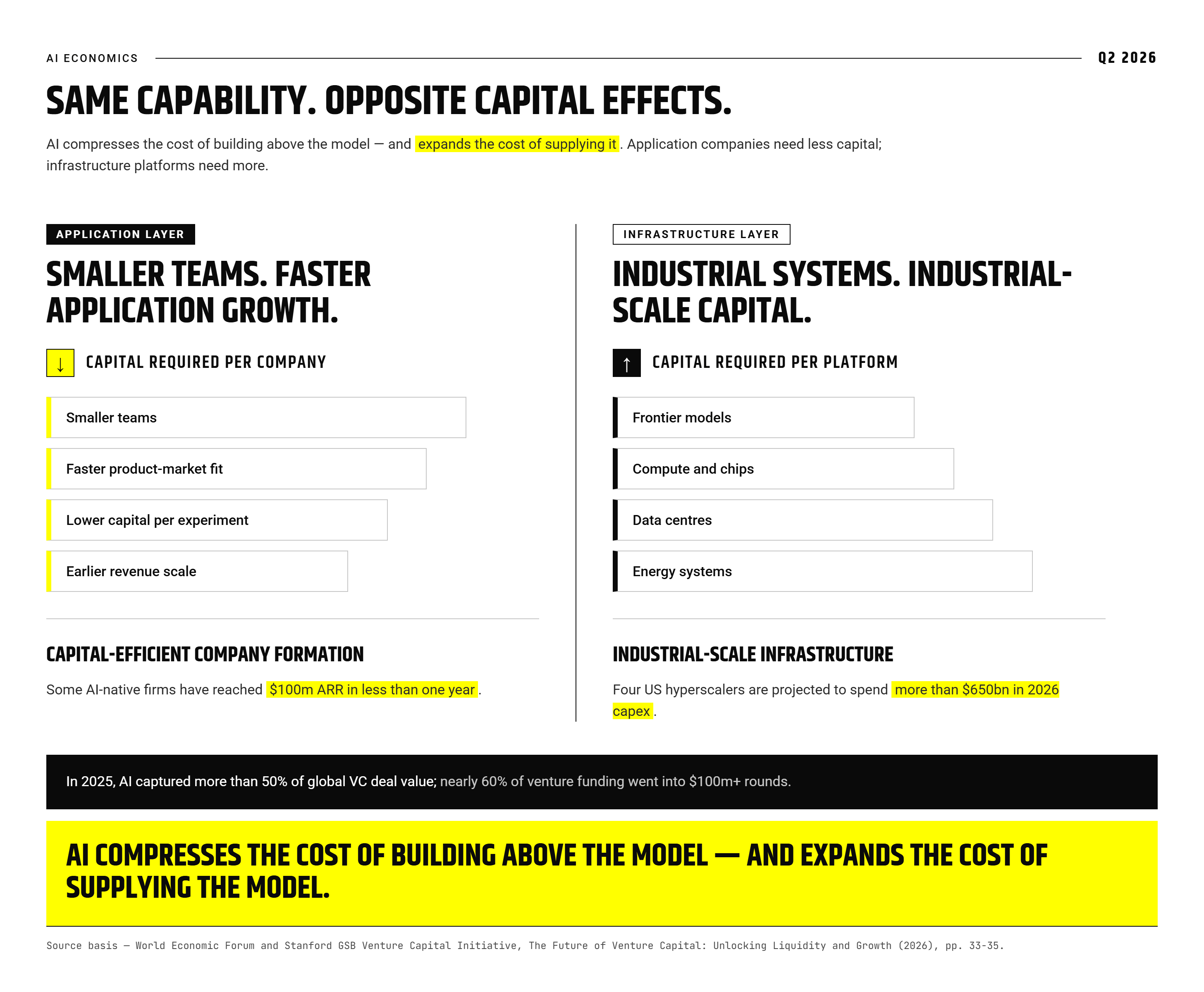
The World Economic Forum and Stanford’s 2026 report on the future of venture capital concludes that AI is simultaneously changing what venture capital finances and the economics of the companies it backs. AI-native firms can reach significant revenue with smaller teams, while the infrastructure beneath them requires industrial-scale capital.13
These two markets need different forms of investment.
Large capital platforms will finance compute, model laboratories and mature category leaders. Specialized early-stage investors can focus on the application layer: the founders embedding intelligence into specific workflows before the opportunity becomes consensus
.
In Q1, we argued that generic venture capital was coming to an end.
Q2 has made the alternative clearer.
The next phase of AI will not be defined only by how intelligent models become. It will be defined by how effectively companies give that intelligence context.
Models will continue to improve, and capital will continue to chase them. But many of the enduring companies may be built one layer above—where intelligence enters the organization, learns how it operates and becomes indispensable.
Intelligence is becoming abundant. Context remains scarce. That is where we invest.
🎚️🎚️🎚️🎚️ Producer’s Note
“Works of art make rules; rules do not make works of art.” — Claude Debussy
The strongest founders do not merely follow an established playbook. Through execution, they create what others later call the playbook.
Disclosure: Fabian Hediger has a personal financial interest in Databricks through a secondary-market investment arranged by Oceanic Partners. This investment is separate from StudioAlpha Fund I. Neither Databricks nor Oceanic Partners sponsored, reviewed, or compensated StudioAlpha for this letter.
StudioAlpha Capital is a Delaware-structured pre-seed venture fund backing AI-native B2B software startups at day zero. Legal counsel: Cooley LLP. Fund administration: AngelList.