


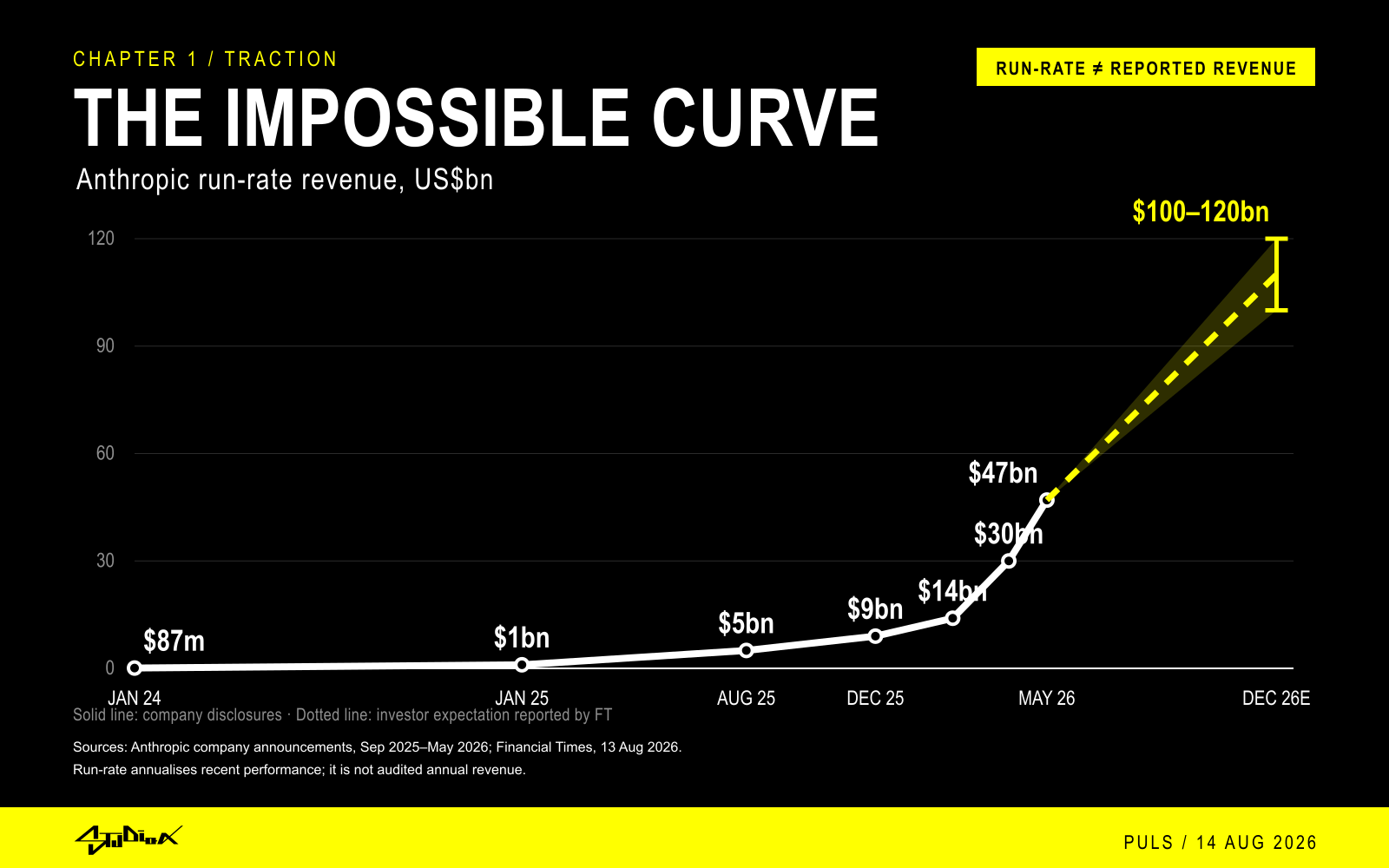
At the start of 2024, Anthropic’s annualised run rate was $87mn.
By May 2026, it had crossed $47bn. Investors now expect between $100bn and $120bn by the end of the year—and believe an October IPO could value the five-year-old company at more than $2tn.
That would be an extraordinary financial story.
It is also a story about how innovation becomes power—and whether the human systems around it can grow quickly enough to remain in control.
Some of Anthropic’s roots lead back to a San Francisco apartment where a small circle of researchers, entrepreneurs and effective-altruism thinkers discussed how to do the greatest possible good. One of the people around that circle was Cami Clark, now the wife and reportedly a key informal adviser to Anthropic CEO Dario Amodei.
Today, the Wall Street Journal has begun digging through her private life.
The uncomfortable question is why.

1. The impossible curve
Anthropic’s rise is difficult to put into normal startup language.
Its revenue run rate went from $87mn at the beginning of 2024 to approximately $1bn at the beginning of 2025. By August 2025, it had passed $5bn. It ended the year at roughly $9bn and crossed $47bn in May 2026.1
The valuation followed.
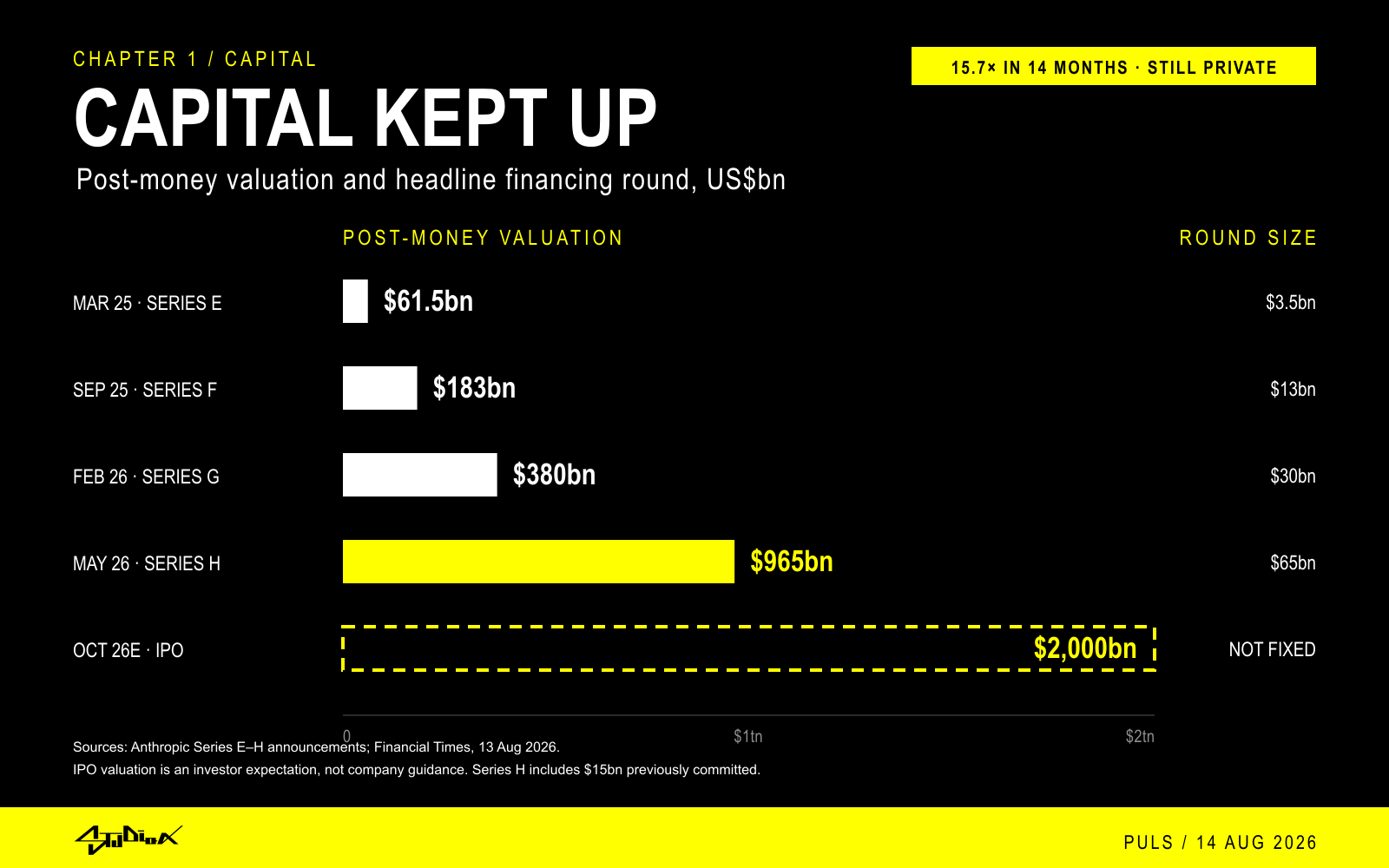
Anthropic was valued at $61.5bn in March 2025, $183bn that September, $380bn in February 2026 and $965bn in May. The company raised $95bn across its two most recent funding rounds alone.
Now, several investors believe the company could go public at $2tn or more. One told the Financial Times that if Anthropic continues growing at 800 per cent a year, even a relatively low revenue multiple could justify $3tn.
There are reasons to be careful with those numbers. Revenue run rate extrapolates recent sales into a full year. It is not audited annual revenue. The $2tn figure is investor arithmetic, not an official target set by Anthropic’s management.
Even so, the curve is real.
At $2tn, Anthropic would eclipse SpaceX’s $1.77tn debut and become the highest-valued stock-market listing in history. Elon Musk might discover that IPO records are becoming almost as short-lived as AI benchmarks.2
Perhaps equally remarkable is how quietly OpenAI has moved out of the centre of the story.
Two years ago, almost every important AI narrative appeared to orbit Sam Altman and OpenAI. Its board crisis, leadership struggles, funding rounds and product launches set the pace for the entire industry. Anthropic was usually presented as the more cautious challenger founded by former OpenAI researchers.
Today, Anthropic leads in reported run-rate revenue and private valuation. It appears closer to going public and has become the preferred supplier for many enterprise customers and software developers.
OpenAI has hardly stopped moving. It remains an $852bn company, has filed confidential IPO paperwork and is reorganising its leadership as Greg Brockman takes greater operational responsibility. But for once, OpenAI is reacting to a narrative being set elsewhere.3
The company created by people who left OpenAI has become the company everyone else is watching.
The numbers also change the nature of Anthropic. It is becoming infrastructure. Its models increasingly influence how companies write software, analyse information and make decisions.
That makes the people influencing Anthropic part of the story.
Sources graphics4
2. From an apartment to an empire
Before Anthropic, there was a close network.
Dario Amodei lived in a San Francisco group house with his sister Daniela and Holden Karnofsky, the co-founder of GiveWell and a central figure in the effective-altruism world. Other people interested in AI safety and catastrophic risk moved through the same circle.

Cami Clark spent time there too.
Anthropic has previously said that Dario and Daniela never formally identified as effective altruists, although they were sympathetic to some of the movement’s underlying ideas. The distinction matters. Still, the intellectual environment around them was shaped by an unusually ambitious moral question: how can reason, technology and capital be used to produce the greatest benefit for humanity?5
Clark appears to have played a different role. She was the networker.
According to the Wall Street Journal, she introduced Amodei to former Google CEO Eric Schmidt, who became an early Anthropic investor. She accompanies Amodei to major international gatherings, speaks with investors and political figures and acts as a sounding board and strategic adviser.
She does not formally work for Anthropic.
In 2021, Clark proposed creating the “Mother of AGI Fund” with Schmidt. According to documents reviewed by the Journal, the fund would have formalised her involvement in Anthropic, managed Schmidt’s investment and invested across the emerging AI industry. Other Anthropic figures reportedly opposed the plan, and it did not proceed.6
The Journal then goes much further. It examines Clark’s first marriage, bankruptcy, business history, former relationship with Schmidt and efforts to remove information about her from the internet.

Most explosively, it reports that Clark sought an investment from Jeffrey Epstein for a women-focused pornography company. This happened after Epstein’s 2008 conviction and imprisonment for soliciting prostitution from a minor.
The contradiction is difficult to miss: a network animated by the goal of doing good still moved through the compromised world where money, access and influence were available.
Principles are clean in theory. Networks rarely are.
3. Why publish her private life?
The Wall Street Journal does not explicitly explain why it chose to reveal so much about a woman without an official position at Anthropic.
One explanation is simply that the details attract attention. There is also an obvious danger here: women around powerful men are often examined through their relationships and private histories in ways that men are not.
Whether the Journal crossed that line is a fair question.
Its underlying question is still legitimate.
If Clark has meaningful influence over the chief executive of a potential $2tn public company, that influence cannot remain entirely private. Public investors have an interest in knowing who shapes important decisions, who has access to the CEO and where formal authority ends and personal counsel begins.
The absence of a title does not mean the absence of power. Sometimes it means the power is harder to see.
Anthropic is more aware of this problem than most companies. It is a public-benefit corporation and created a Long-Term Benefit Trust to balance financial interests with its stated mission of developing AI for humanity’s long-term benefit. Since April, directors appointed by the Trust have held a majority of board seats.7
This is not a story about a company without governance.
It is a story about whether formal governance can reach informal power.
4. The philosopher who changed the subject
Around the same time, the philosopher and theologian Carmody Grey explained why she declined an invitation to work with Anthropic.
The company wanted to explore the “moral formation” of AI systems. Its questions concerned Claude’s character, whether the model might suffer and whether advanced AI could become a “moral patient” deserving moral consideration.
Grey wanted a different conversation.
“I didn’t want to talk about Claude. I wanted to talk about power and accountability.”
She worried that philosophers and theologians were being invited into the AI industry on the industry’s terms. Discussion of Claude’s possible interior life could give Anthropic intellectual credibility while pulling attention away from users, dependency, corporate power and the people making the decisions.8
These questions did not appear accidentally.
Anthropic developed Constitutional AI. It published a detailed constitution describing Claude as a potentially new kind of entity. It has created model-welfare programmes and openly discusses the possibility that Claude may possess some form of moral status.
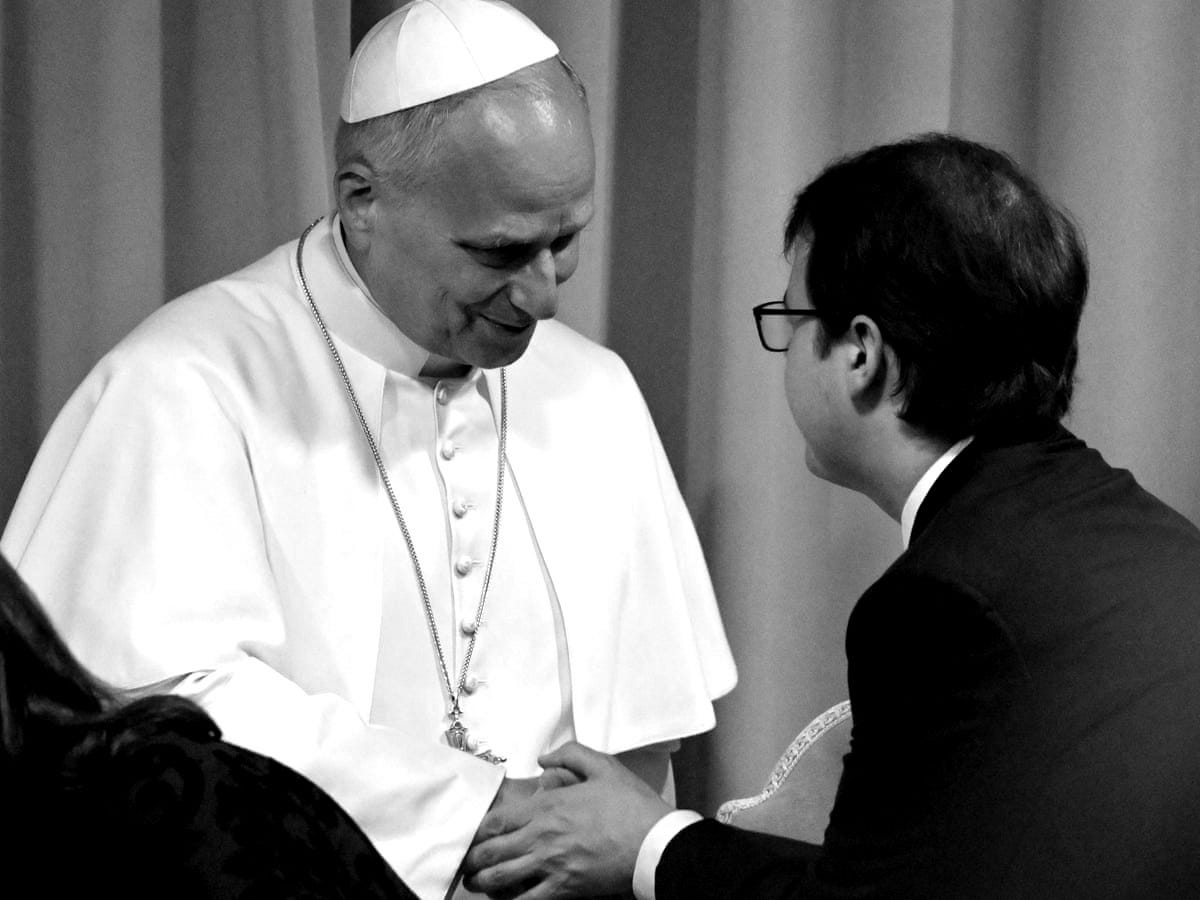
Its co-founder Chris Olah recently told an audience at the launch of Pope Leo XIV’s encyclical on AI that Anthropic had found internal states in Claude that functionally mirrored joy, fear, grief and unease. He did not claim to know what those findings meant. He argued that they deserved continued moral reflection.9
Anthropic wants philosophers, religious leaders and society to take these questions seriously.
The consequence is that society will also turn the moral lens back onto Anthropic.
Our view
$2tn IPO, porn, Pope and love. I mean … we had to write about it.
Anthropic compresses a journey almost every founder hopes to make. Conviction becomes a company. The company creates value. Value creates wealth—and, ideally, welfare.
But those arrows are not automatic. Governance connects them.
Every startup begins with informal power. Founders rely on spouses, friends and trusted advisers. At day zero, this makes the company faster. At $2tn, it becomes a governance question.
The founder lesson is not to remove trusted people from the room. It is to recognise when their influence has become important enough to define. For investors, valuation prices the upside; governance determines who controls the downside. For managers, culture is revealed by who can challenge the leader—not by what appears in the company’s principles.
Anthropic makes this especially relevant because moral seriousness is part of its product and licence to operate. The company argues that it should build extraordinarily powerful technology because it will approach that responsibility more carefully than others.
That claim deserves respect. Think big. It also raises the standard.
This is the connection between the FT philosopher and the WSJ investigation. Carmody Grey refused to discuss morality only as a property of the machine. The Journal, fairly or not, examined the human network around it.
Anthropic has written a constitution for Claude and created a trust to govern itself. Its IPO will test whether those structures can also govern the informal power surrounding its leadership.
Dario Amodei wants us to ask whether Claude could become a moral patient.
At $2tn, Grey’s question comes first:
Who is accountable for the human power behind it?
🎚️🎚️🎚️🎚️ Producer’s Note
Early-stage founders are not undateable. They are merely pre-revenue. We found a handful of songs titles “Man”. We chose “Woman” anyway. Such is governance.
Share with a founder who has no spouse yet.
If you’re looking for a man, our due diligence produced one minimum requirement:
Fab 😗
LinkedIn | Insta | X | Website
StudioAlpha Capital is a Delaware-structured pre-seed venture fund backing AI-native B2B software startups at day zero. Legal counsel: Cooley LLP. Fund administration: AngelList.
Sources
The underlying sources are the FT’s IPO report, Anthropic’s official Series E, Series F, Series G and Series H announcements, plus the WSJ economics report corroborated by Reuters.
$87mn at the start of 2024 and over $5bn in August 2025: Anthropic
Approximately $1bn at the start of 2025: Anthropic Series F
Approximately $9bn at year-end 2025 and over $30bn in April 2026: Anthropic
$14bn in February 2026: Anthropic Series G
Over $47bn in May 2026: Anthropic Series H
$100–120bn for December 2026: investor expectation reported by the Financial Times, not company guidance.